How Can BigBasket Zepto Blinkit Grocery Price Comparison Expose a 15% Price Difference Across Top Apps?
Introduction
India’s quick commerce industry has transformed the grocery shopping experience, with platforms like BigBasket, Zepto, and Blinkit promising ultra-fast delivery within minutes. A detailed BigBasket Zepto Blinkit Grocery Price Comparison reveals that the same grocery basket can vary in cost by as much as 15% depending on the platform and location.
Advanced data extraction techniques now allow businesses to monitor grocery pricing trends across platforms in real time. By leveraging Quick Commerce Product & Price Data Scraping, companies can collect product listings, discount information, delivery fees, and stock availability across multiple grocery apps. This enables analysts to track market competition, evaluate pricing strategies, and identify opportunities for cost optimization.
Understanding pricing patterns is no longer limited to consumers comparing carts. Retailers, market analysts, and brands now rely on large-scale datasets to determine where price gaps occur and how those gaps influence buying behavior. The following sections examine how systematic data analysis reveals price disparities across India’s leading quick commerce apps.
Understanding Price Variations Across Major Quick Commerce Grocery Platforms
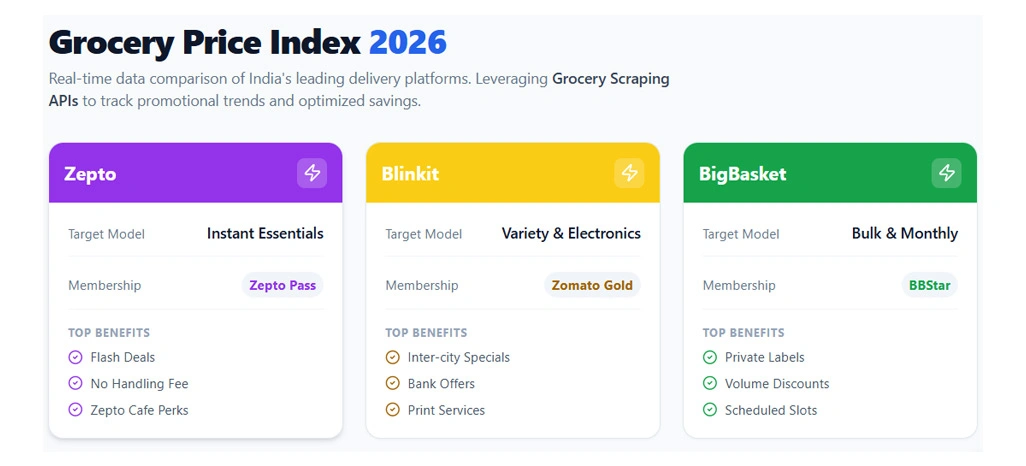
Consumers often expect grocery prices to remain similar across delivery apps, but real-world datasets reveal noticeable variations. When analysts conduct a BigBasket vs Zepto vs Blinkit Price Analysis, they often observe that even identical products may appear at different price points depending on the platform and the city.
A detailed review of the BigBasket Grocery Data Dataset reveals that pricing stability often varies by category. Staples like rice, flour, and cooking oil usually maintain relatively consistent prices because suppliers distribute them in bulk across warehouses. However, fresh produce and branded packaged goods tend to fluctuate more frequently due to inventory turnover and seasonal demand.
Some grocery apps provide direct reductions in product prices, while others rely on wallet credits, coupon-based campaigns, or bundle deals. Retail analysts studying grocery apps frequently observe that price differences of just a few rupees per product can accumulate significantly across a full shopping basket.
Example Product Price Comparison:
| Product | BigBasket Price (₹) | Zepto Price (₹) | Blinkit Price (₹) |
|---|---|---|---|
| Amul Milk 1L | 68 | 70 | 69 |
| Tomatoes 1kg | 32 | 28 | 35 |
| Basmati Rice 5kg | 420 | 445 | 435 |
| Eggs (12 pack) | 78 | 82 | 80 |
Price gaps become even clearer when analyzed across different grocery baskets.
| Basket Type | Average Price Difference |
|---|---|
| Vegetables Basket | 8–12% |
| Dairy Basket | 4–7% |
| Packaged Food Basket | 10–15% |
These observations illustrate how structured datasets help reveal competitive price positioning across the quick commerce grocery ecosystem.
Impact of Competitive Strategies on Grocery App Pricing
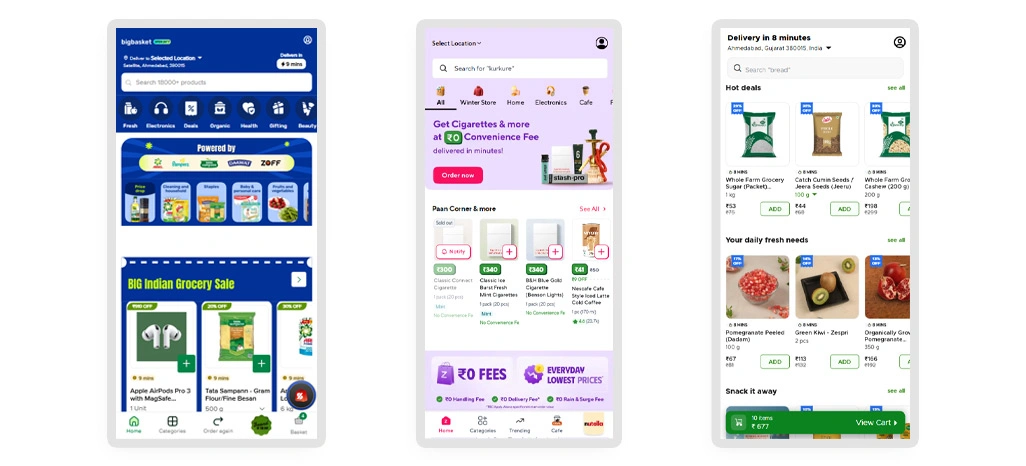
The rapid growth of instant grocery delivery has intensified competition between major platforms. Analysts frequently describe the current market as a Blinkit Zepto BigBasket Grocery Price War, where each platform adjusts pricing strategies to attract and retain customers.
Pricing decisions are no longer static. Insights from Zepto Grocery Product & Price Datasets indicate that certain products may change price several times within a single day depending on inventory levels, demand spikes, and promotional events. Consumers often search for clarity when deciding which platform to order from. Questions like BigBasket vs Zepto vs Blinkit Which Is Cheaper have become common among frequent grocery shoppers trying to optimize spending across multiple apps.
However, determining the cheapest platform is rarely straightforward. Price leadership can change depending on product categories. For instance, one platform may offer lower prices on fresh vegetables while another focuses on discounted packaged goods.
Example Category-Level Price Comparison:
| Category | BigBasket Avg Price (₹) | Zepto Avg Price (₹) | Blinkit Avg Price (₹) |
|---|---|---|---|
| Fruits | 120 | 110 | 118 |
| Vegetables | 95 | 88 | 92 |
| Packaged Foods | 210 | 225 | 215 |
Basket-level analysis provides further insight into platform competitiveness.
| Basket Size | Lowest Price Platform | Average Savings |
|---|---|---|
| Small Basket | Zepto | 7% |
| Medium Basket | Blinkit | 10% |
| Large Basket | BigBasket | 12% |
Such comparisons highlight how competitive strategies shape pricing behavior across India’s fast-growing quick commerce sector.
Using Data Monitoring Methods to Study Grocery Pricing Trends
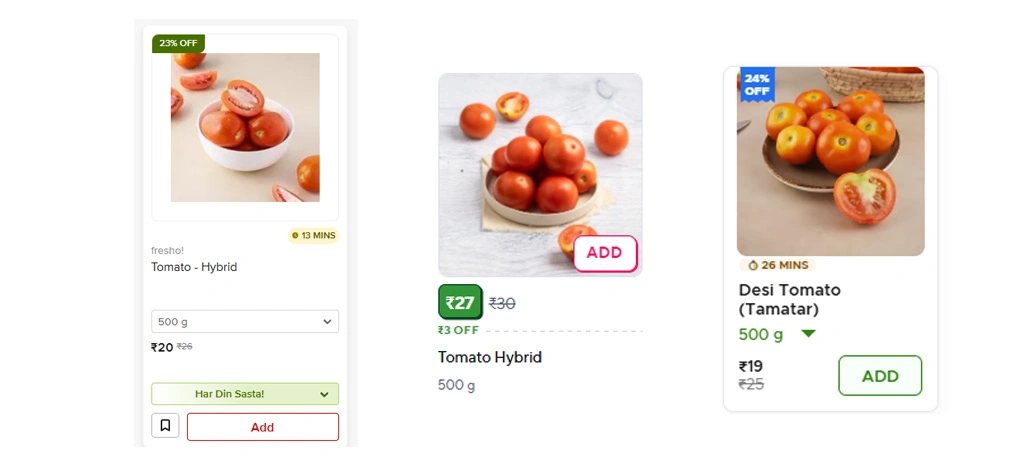
Tracking grocery pricing across multiple apps has become essential for retailers, brands, and market researchers. Technologies like Grocery Price Tracking Using Web Scraping enable businesses to collect large-scale datasets containing product listings, discount structures, stock availability, and delivery charges across platforms.
These insights allow analysts to determine Who Is Cheaper Blinkit Zepto or BigBasket within specific product categories or geographic regions. By analyzing thousands of SKUs simultaneously, businesses can identify pricing leaders and detect sudden market shifts.
Another growing focus in the analytics industry involves learning How to Analyze Grocery Price Wars Using Scraped Data effectively. This approach combines automated data collection with statistical modeling and competitive benchmarking to monitor pricing strategies across multiple grocery apps. Such analysis often reveals that promotional campaigns and flash sales play a significant role in temporary price advantages.
Multi-App Price Monitoring Example:
| Product Category | Price Leader | Average Gap |
|---|---|---|
| Vegetables | Zepto | 9% |
| Dairy | BigBasket | 5% |
| Packaged Snacks | Blinkit | 11% |
Promotional strategies also influence temporary price differences across platforms.
| Campaign Type | Typical Discount |
|---|---|
| App Flash Sale | 10–18% |
| Membership Deals | 5–12% |
| Bundle Offers | 8–20% |
Continuous monitoring of these datasets helps brands understand competitive pricing movements and refine their own product positioning within the quick commerce marketplace.
How Retail Scrape Can Help You?
Price Intelligence in quick commerce requires accurate and continuous data monitoring. We enable organizations to perform large-scale BigBasket Zepto Blinkit Grocery Price Comparison analysis using automated data collection systems designed for high-frequency updates across multiple grocery apps.
Key Capabilities:
- Automated product catalog monitoring across grocery apps.
- Multi-city price tracking for thousands of SKUs.
- Discount and promotion detection.
- Delivery fee and surge pricing monitoring.
- Product availability and stock tracking.
- Historical price trend analysis.
These insights help retailers identify market opportunities and adjust their pricing strategies effectively. Businesses also rely on Scraping Grocery Delivery Apps for Price Intelligence to track competitor movements and maintain competitive product positioning.
Conclusion
Price fluctuations across grocery delivery platforms highlight the importance of continuous monitoring. Detailed BigBasket Zepto Blinkit Grocery Price Comparison studies reveal that small product-level differences can accumulate into double-digit percentage variations in total basket costs across apps.
Retailers and analysts increasingly evaluate datasets to understand Which Grocery App Is Cheapest in India Today, allowing them to adapt pricing strategies and remain competitive in the quick commerce market. Businesses looking to implement large-scale grocery pricing intelligence can connect with Retail Scrape today to access real-time analytics and market insights.
Effortlessly managing intricacies with customized strategies.
Mitigating risks, navigating regulations, and cultivating trust.
Leveraging expertise from our internationally acclaimed team of developers
Reliable guidance and assistance for your business's advancement